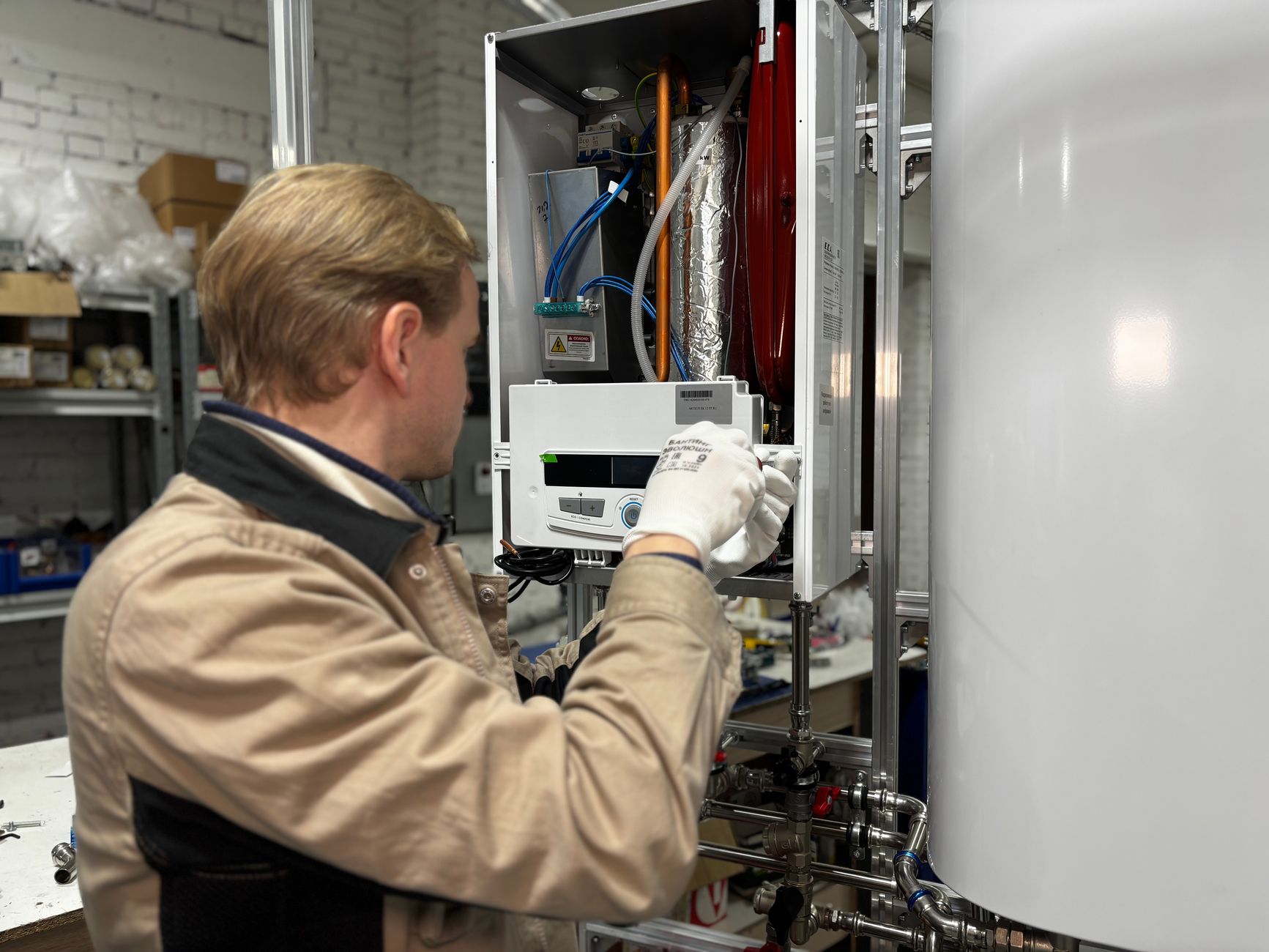
Waking up to a cold shower usually means one of a few things: a tripped reset switch, a thermostat that's lost its setting, or a pilot light that's gone out. The exact fix depends heavily on whether you have a gas or electric water heater, since the two systems fail — and reset — in completely different ways. This guide walks through both, so skip to the section that matches your unit.
Before doing anything else, find your water heater's data plate (usually on the upper third of the tank) and confirm whether it's gas or electric. It'll say plainly, and gas units will have a burner compartment and flue at the top; electric units won't have a flue and usually have a simple round or rectangular access panel instead.
First: Rule Out the Easy Stuff
Before touching the heater itself, check these two things — they cause a surprising share of "no hot water" calls:
- Breaker panel: For electric units, confirm the dedicated water heater breaker (usually a double-pole 30-amp breaker) hasn't tripped. Flip it fully off, then back on.
- Gas supply: For gas units, check that the gas shutoff valve on the pipe leading to the heater is parallel to the pipe (open), not perpendicular (closed). Also confirm other gas appliances in the house are working, which tells you whether the issue is heater-specific or a supply problem.
If those check out, move to the section for your unit type.
Resetting a Gas Water Heater
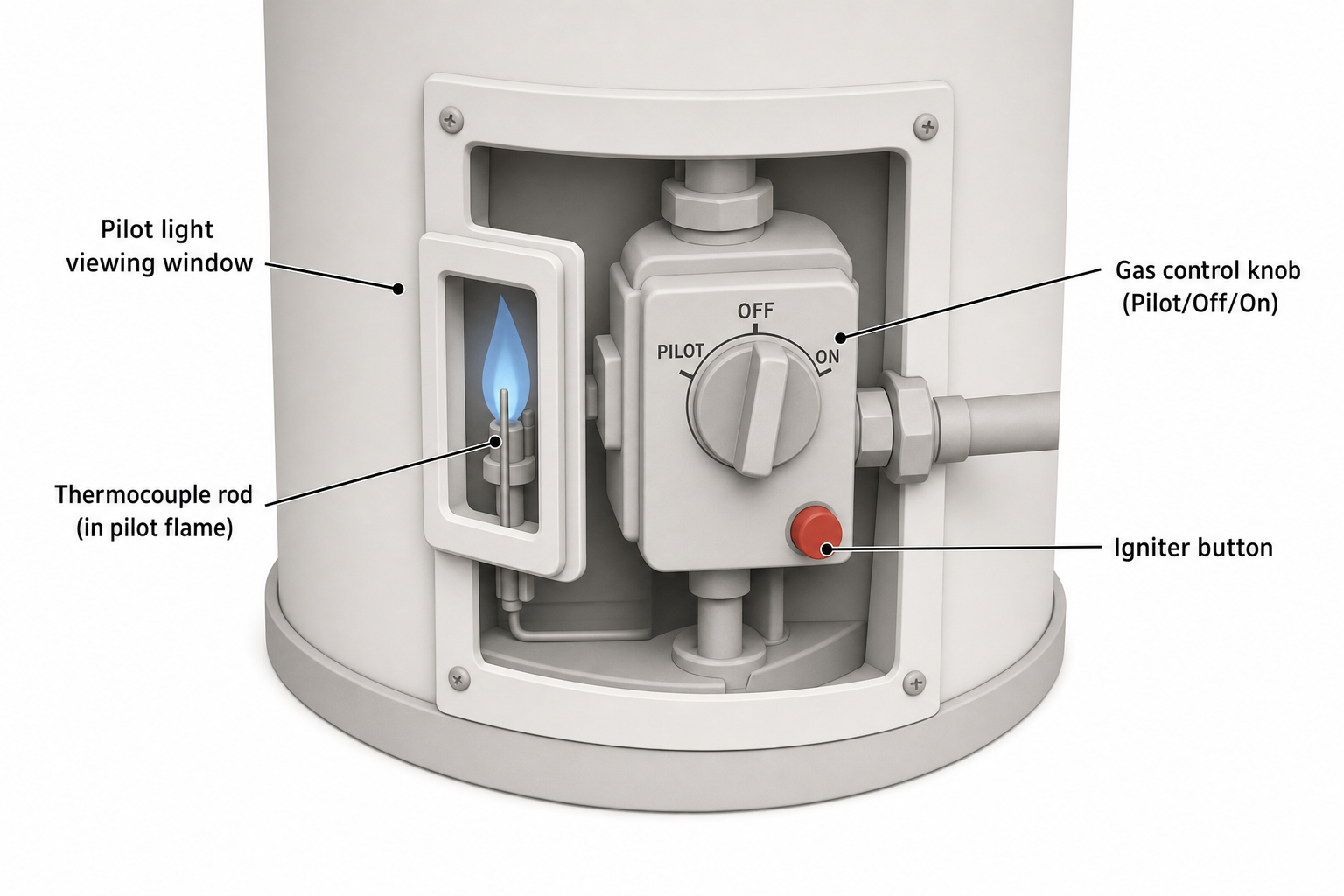
Most residential gas water heaters make ignition and safety controls easy to see: a control valve on the front of the tank with a dial (Pilot/Off/On) and often a red reset or ignition button.
Step 1: Check the Pilot Light
Most gas units have a small viewing window or removable access panel near the bottom of the tank. Look through it for a small blue flame — that's the pilot.
- If the pilot is lit: the problem is likely elsewhere (thermocouple, thermostat, or a gas valve issue) — consider calling a professional if the burner still won't fire on demand.
- If the pilot is out: you'll need to relight it, which is often the actual "reset."
Step 2: Relight the Pilot
- Turn the gas control knob to "Off" and wait about 5 minutes to let any residual gas clear.
- Turn the knob to "Pilot."
- Press and hold the control knob (this opens gas to the pilot) while using the igniter button or a long lighter to ignite the pilot through the viewing port.
- Hold the knob down for 30–60 seconds after ignition — this lets the thermocouple heat up enough to keep the gas valve open on its own. Manufacturers typically specify a hold time in this range on the label attached to the tank; follow that instruction over general guidance if it differs.
- Release the knob and check that the pilot stays lit. Turn the dial to "On."
If the pilot won't stay lit after a couple of attempts, the thermocouple (a thin sensor rod near the pilot flame) is a common failure point and usually needs replacing — this is a low-cost part but does involve working with a live gas line fitting, so many homeowners hire this out.
Step 3: Check the Thermostat Dial
On the same control valve, there's usually a temperature dial. If it's been bumped to a low setting or "Vacation" mode, hot water will feel weak or absent even with a working pilot. Set it to the manufacturer-recommended range — commonly around 120°F (49°C) for household safety, though some manufacturers allow higher settings on specific models. Give the tank 30–60 minutes to reheat a full tank before judging results.
Resetting an Electric Water Heater
Electric units don't have a pilot light at all — they use one or two heating elements controlled by thermostats, plus a high-temperature cutoff switch that's often mistaken for "the reset."
Step 1: Kill Power First
Before removing any access panels, switch off the dedicated breaker at your panel. Electric water heaters run on 240-volt circuits, and the internal components are live whenever the breaker is on.
Step 2: Find the Reset Button
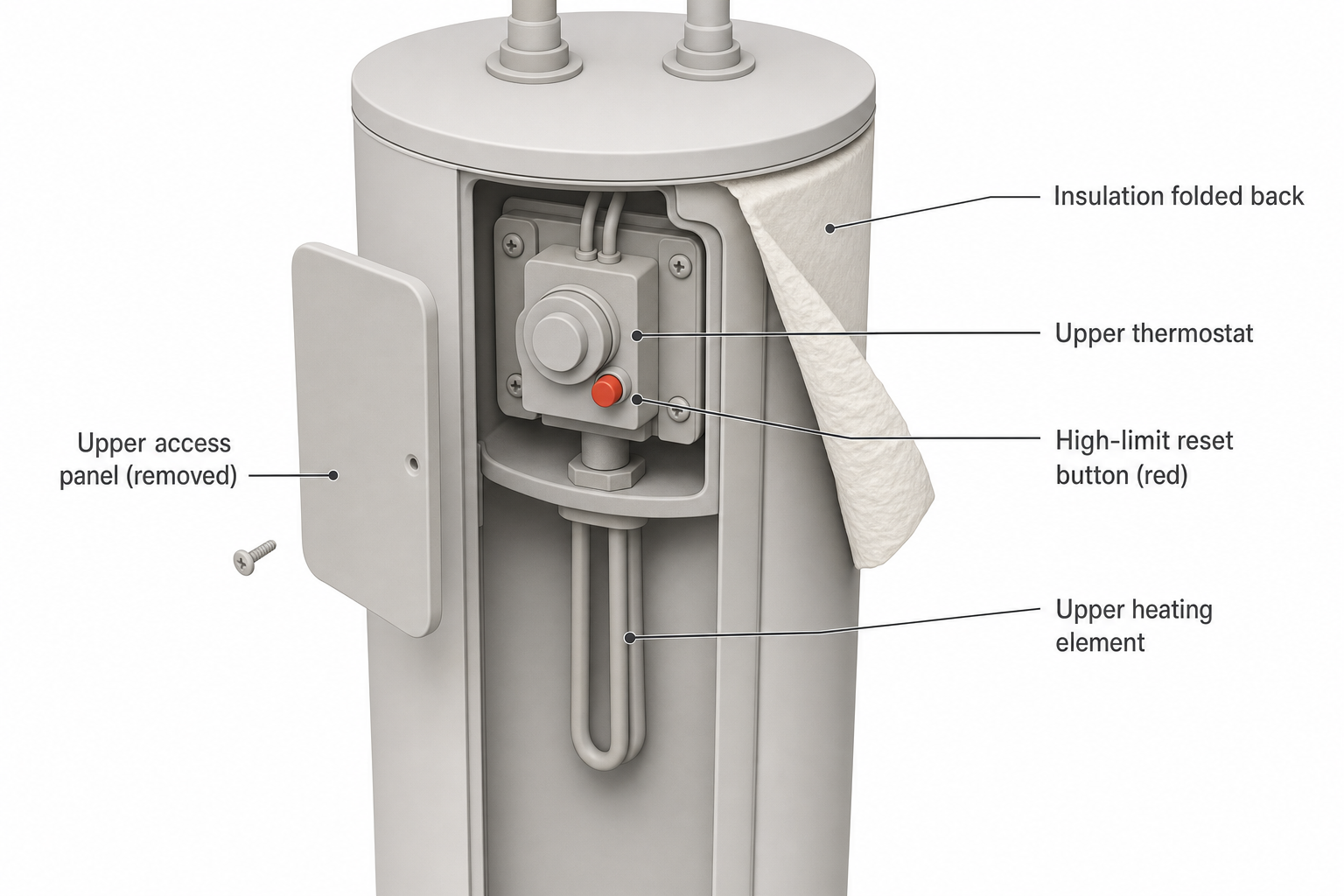
Remove the upper access panel (usually one or two screws) and fold back the insulation. You'll see a thermostat with a small red or yellow button — this is the high-limit reset switch (sometimes called an ECO, or energy cutoff). It trips when water gets too hot, cutting power to the elements as a safety measure.
- With the breaker off, press the reset button firmly until you hear or feel a click.
- Replace the insulation and panel.
- Restore power at the breaker.
- Wait 30–60 minutes and check for hot water.
If the reset button trips again shortly after resetting, that's a signal of a deeper problem — commonly a failing thermostat or a shorted heating element — rather than a one-time fluke. Repeatedly resetting it without diagnosing the cause risks nuisance tripping or, in worse cases, an element failure.
Step 3: Check Both Thermostats (Upper and Lower)
Most tank-style electric heaters have two thermostats: one behind the upper panel, one behind the lower panel. Confirm both are set to the same temperature, typically in the 120°F (49°C) range unless the manufacturer's guidance differs. A mismatch or a thermostat stuck at a low setting can cause lukewarm or absent hot water even when elements are otherwise fine.
If you're comfortable with a multimeter, checking for continuity across each heating element (with power off and the element disconnected) will tell you whether an element has burned out — a very common cause of no hot water in electric tanks, especially in older units or in areas with hard water that accelerates element buildup.
When a Reset Doesn't Fix It
If you've relit the pilot, reset the high-limit switch, and confirmed thermostat settings but still have no hot water, the likely culprits are:
- A failed thermocouple or gas valve (gas units)
- A burned-out heating element or failed thermostat (electric units)
- Sediment buildup insulating the burner or elements from the water, especially in tanks that have never been flushed
- A tank that's simply reached the end of its service life — most manufacturers estimate 8–12 years for typical tank water heaters, though this varies with water quality and maintenance
At this point, it's reasonable to bring in a licensed plumber, particularly for gas valve or element replacement, both of which involve safety-relevant components.
FAQ
Why does my water heater keep tripping the reset button? A reset button (high-limit switch) that trips repeatedly usually means water is getting hotter than it should, often due to a stuck or failed thermostat, a shorted heating element, or a thermostat set too high. Repeated tripping isn't something to keep resetting indefinitely — it's worth having a professional check the thermostats and elements.
Is it safe to relight a gas water heater pilot myself? Yes, for most homeowners, relighting a pilot following the instructions on the manufacturer's label is a normal maintenance task. Stop immediately and call a professional if you smell gas, if the pilot won't stay lit after a couple of tries, or if you're uncomfortable with any part of the process.
How long does it take for a water heater to heat up after a reset? Most residential tanks take roughly 30 minutes to an hour to reheat a full tank of water after relighting a pilot or resetting the high-limit switch, though larger tanks or lower-wattage electric elements can take longer.
Why does an electric water heater have no reset button visible? The reset button is usually hidden behind an access panel and a layer of insulation on the upper thermostat. If you don't see one, remove the panel screws and gently pull back the insulation — it's a small red or yellow button set into the thermostat itself.
Can a full tank of sediment cause no hot water at all? Heavy sediment buildup is more likely to cause reduced hot water, popping/rumbling noises, or slower recovery than a complete loss of hot water, but severe buildup can insulate a lower heating element enough to cause it to fail, which would cut off hot water entirely. Periodic tank flushing, per manufacturer guidance, helps prevent this.