When your refrigerator's ice maker suddenly stops producing ice, the cause is almost always one of a handful of predictable culprits: a frozen or restricted water line, a clogged filter, a faulty water inlet valve, or a worn-out ice maker module. Working through these possibilities in order—from simplest to most involved—will save you a service call in most cases.
Start With the Basics
Before assuming a mechanical failure, rule out the obvious:
- Check the freezer temperature. Ice makers generally need the freezer at 0in... actually, check that the freezer thermometer reads about 0°F to 5°F. Most ice maker modules won't cycle if the freezer runs warmer than that.
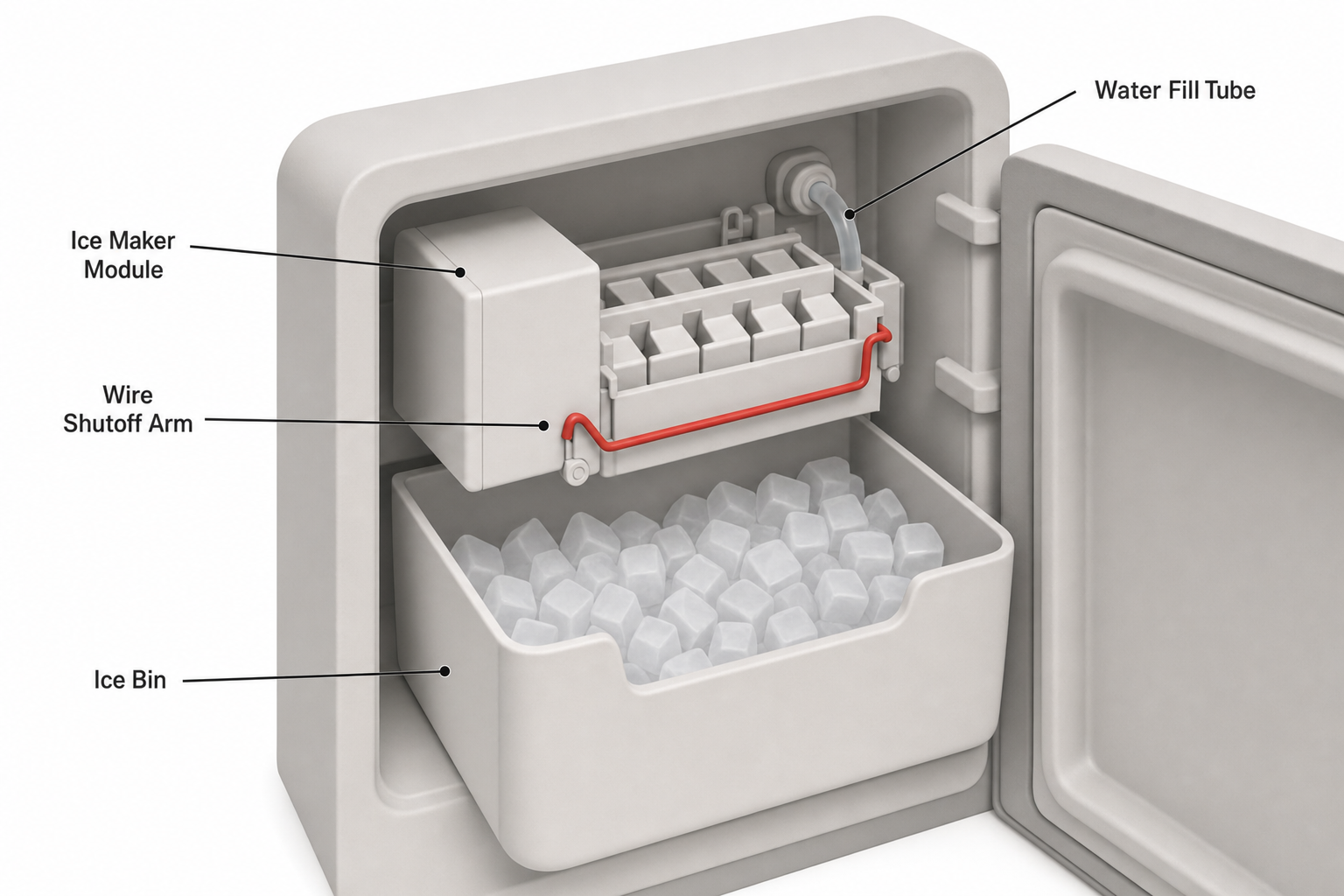
- Confirm the ice maker is turned on. Many units have a power switch or an on/off arm/lever on the front of the module. If the wire shutoff arm has been bumped into the "off" (raised) position, the unit won't cycle at all.
- Look for a full bin. Some ice makers use an infrared sensor instead of a mechanical arm; if the sensor is blocked or the bin sensor thinks it's full, production stops.
- Listen for a fill sound. Every 90 minutes to a few hours (depending on the model), you should hear a brief whirring or water-fill sound. No sound at all often points upstream, to the water supply.
Step 1: Check for a Frozen or Kinked Water Line
The most common reason an ice maker stops cold (literally) is that the water line supplying it has frozen or is pinched.
- Unplug the refrigerator or shut off power at the breaker before pulling it away from the wall.
- Pull the fridge out and inspect the flexible water line running from the wall shutoff valve to the back of the refrigerator, and the smaller tube that runs from the back panel up into the freezer compartment.
- Feel for a kink where the line bends behind the unit, especially if the fridge was recently moved or pushed back too far against the wall.
- If the interior fill tube (usually plastic, running along the freezer's back or side wall) feels solid or icy, it's likely frozen. This commonly happens when the freezer door was left ajar, the door gasket is failing, or the freezer is running colder than necessary.
To thaw a frozen line: unplug the refrigerator, remove the back panel of the freezer (typically held by a few screws), and let it sit for {measure:2 hours} to {measure:4 hours}, or gently warm the tube with a hair dryer on low heat. Never use an open flame. Once thawed, check the door seal and freezer temperature setting to prevent it from happening again.
Step 2: Inspect the Water Supply Line and Shutoff Valve
If the internal line isn't frozen, trace the problem back further:
- Locate the shutoff valve, usually under the kitchen sink or in the basement/utility area behind the refrigerator, and confirm it's fully open.
- Check for mineral buildup or corrosion at a saddle valve (a valve that pierces directly into a copper pipe). Saddle valves are prone to clogging over time and are widely considered a common weak point in ice maker plumbing.
- If your home was recently on well water or has hard water, sediment can restrict flow to the water inlet valve.
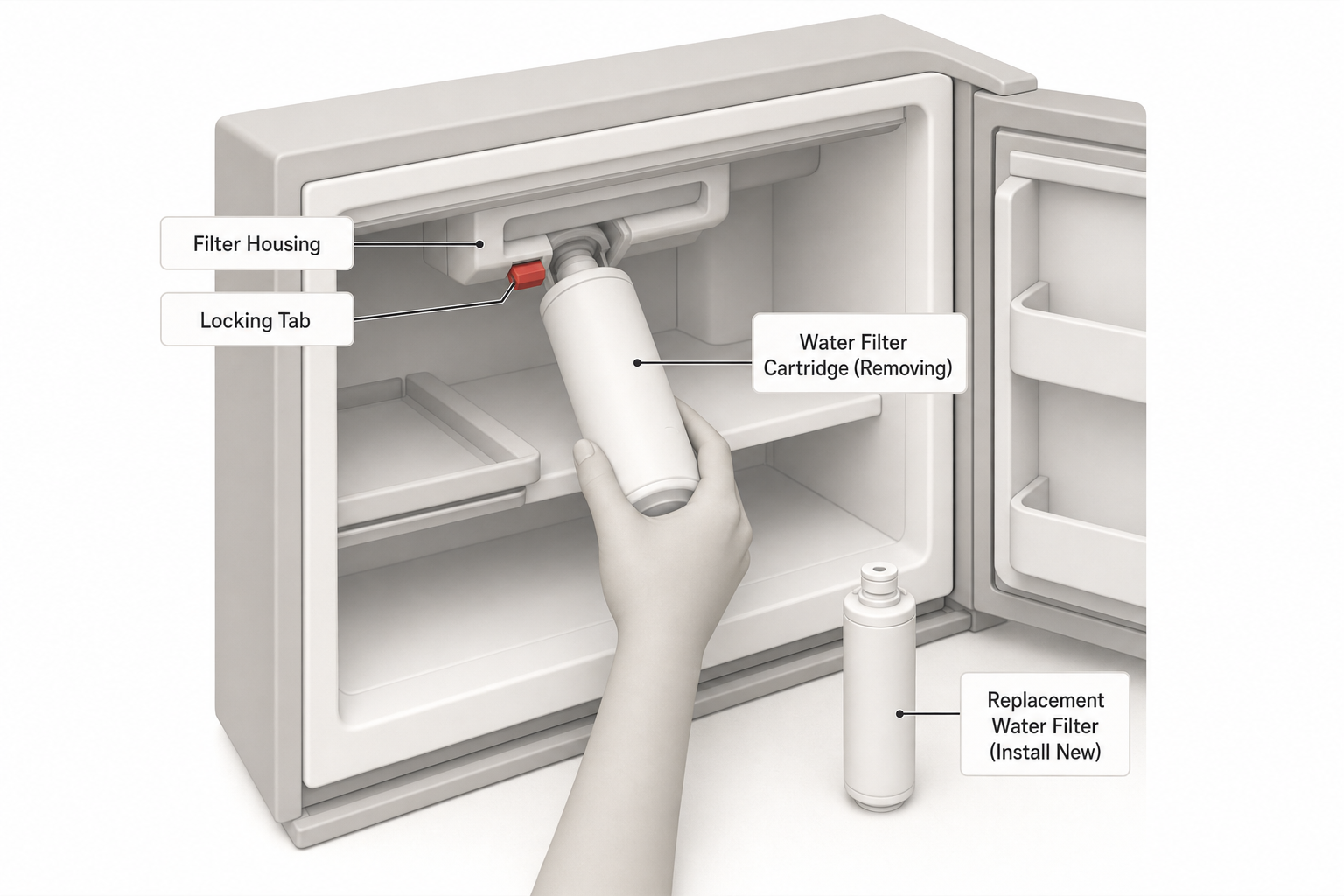
Step 3: Replace the Water Filter
A clogged filter is one of the most overlooked causes of low or no ice production.
- Most manufacturers recommend replacing the in-fridge water filter every 6 months, though households with heavy usage or hard water may need it sooner.
- A filter that's overdue often causes slow ice production before it stops entirely, along with reduced water dispenser flow.
- After installing a new filter, flush the line by dispensing water for 3-5 minutes to clear air pockets and carbon fines, then give the ice maker a few hours to resume its normal cycle.
- If your model has a filter bypass plug, you can test whether the filter itself is the problem by temporarily installing the bypass and seeing if ice production resumes.
Step 4: Test the Water Inlet Valve
The water inlet valve is a solenoid-operated valve, typically located behind the refrigerator at the bottom rear, that opens briefly to let water flow to the ice maker and dispenser.
- With the fridge unplugged and pulled out, locate the valve where the water line connects to the appliance.
- Check the incoming water pressure. Most inlet valves need a minimum of around 20 psi to function correctly; on very low-pressure systems, the valve may open but not deliver enough water to fill the mold.
- A multimeter can be used to test the valve's solenoid coil for continuity; a reading of infinite resistance (open circuit) generally indicates a failed valve. Comparing against the resistance value listed in the appliance's service documentation is the most reliable check.
- Inlet valves are a common failure point after 5-10 years of service and are usually sold as a straightforward bolt-on replacement part.
Step 5: Examine the Ice Maker Module Itself
If water is reaching the freezer compartment but no ice is forming, the module (the mechanical or electronic unit that runs the fill-freeze-harvest cycle) may be at fault.
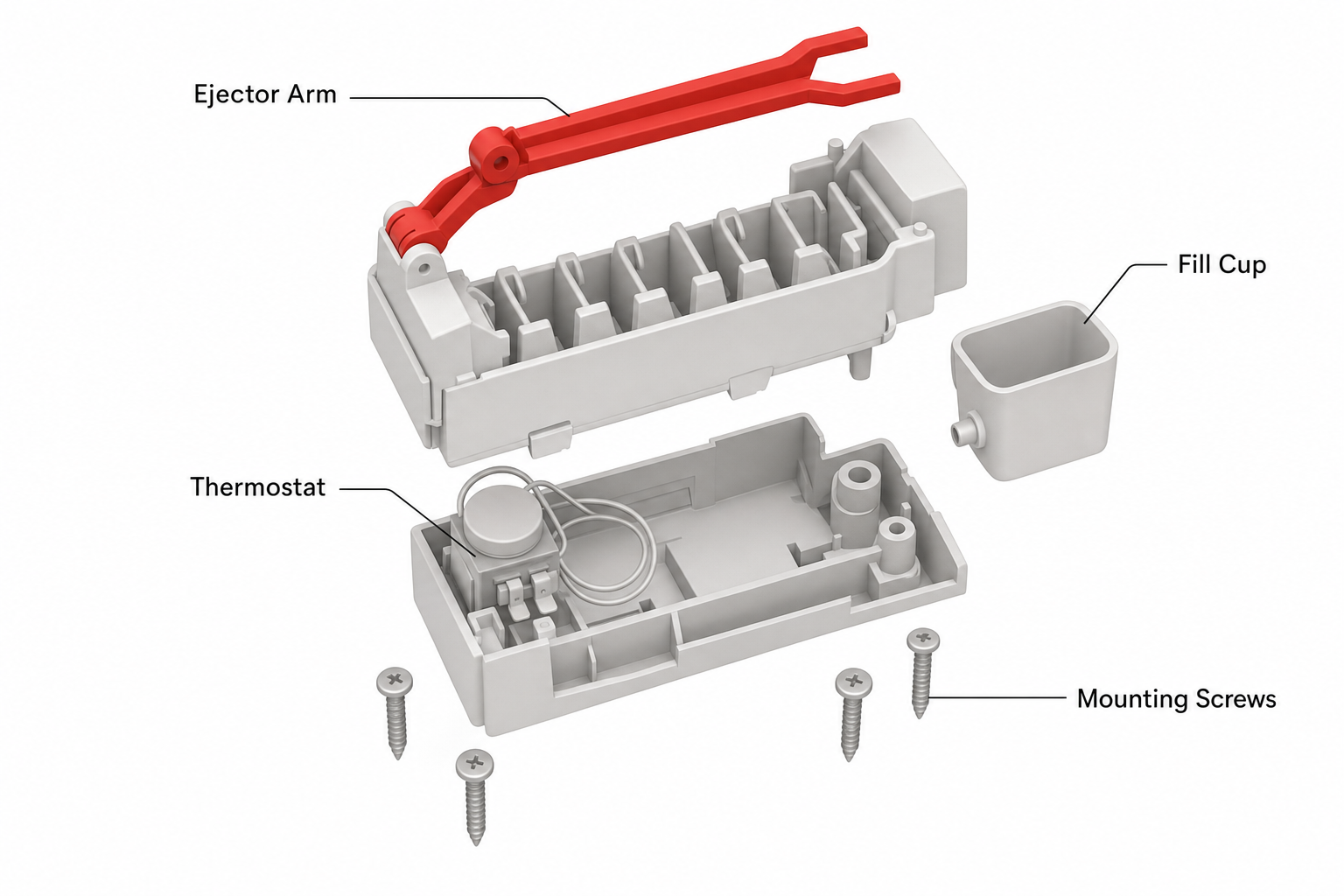
- Listen for the harvest cycle. Every cycle, you should hear the module rotate the ejector arm or twist tray to release ice. Silence usually points to a failed motor or control board inside the module.
- Check the thermostat/thermistor. Older mechanical ice makers use a thermostat that senses when the ice is frozen enough to harvest; if it fails, the cycle never triggers.
- Inspect for physical damage. Ice jams, especially from an undersized or misaligned ice bin, can strip the module's internal gears over time.
- Reset the module. Many units have a test or reset button; consult your model's manual for the correct button-press sequence, which is often a specific held-down duration rather than a quick tap.
On most modern refrigerators, the ice maker module is a sealed, non-serviceable unit—when it fails internally, replacement of the whole module is the standard fix rather than attempting an internal repair.
When to Call a Professional
If you've confirmed the freezer temperature is correct, the filter is fresh, the line isn't frozen, and the water inlet valve tests fine, the issue may be a wiring fault, a failed main control board, or a sealed refrigerant system problem affecting freezer temperature. These diagnoses often require specialized tools and appliance-specific wiring diagrams, so a licensed appliance repair technician is the appropriate next step, particularly if the refrigerator is still under manufacturer warranty—DIY disassembly can void coverage.
FAQ
Why did my ice maker stop working after I changed the water filter? A new filter cartridge can trap air in the line, or an incorrectly seated filter can restrict flow entirely. Run the dispenser for several minutes to clear air and confirm the filter clicked fully into place; production typically resumes within a few hours.
How long does it take for an ice maker to start making ice after being reset or reconnected? Most units take {measure:2 hours} to {measure:24 hours} to produce the first batch of ice after a reset, refill, or after the freezer reaches proper temperature, since the mold has to freeze fully before the first harvest cycle triggers.
Can hard water cause an ice maker to stop working? Yes. Mineral scale can build up inside the water inlet valve, the filter, and even the fill tube, gradually restricting flow until the ice maker stops receiving enough water to form cubes. Softening the water supply or replacing filters more frequently can help.
Is it normal for the ice maker to pause production in winter? In homes where the water supply line runs through an unheated space like a garage or crawlspace, cold snaps can chill or freeze the line even if the rest of the plumbing is fine. Insulating exposed sections of the line can prevent seasonal freeze-ups.
Should I turn off the ice maker if I'm not using it for a while? Yes, if you'll be away for more than a few days, switching off the ice maker (via its power switch or by lifting the shutoff arm) and shutting the water supply valve can prevent stagnant water buildup and reduce the risk of a slow leak going unnoticed.