
A lawn that's mostly green but dotted with brown patches is frustrating because the cause isn't always obvious. The three most common culprits—grub damage, fungal disease, and dog urine—look similar at a glance but respond to completely different fixes. Treat the wrong one and you'll waste a season watching the patches spread. This guide walks through how to tell them apart and what to actually do about each.
Step 1: Look at the Shape and Pattern First
Before digging into causes, study the patches themselves:
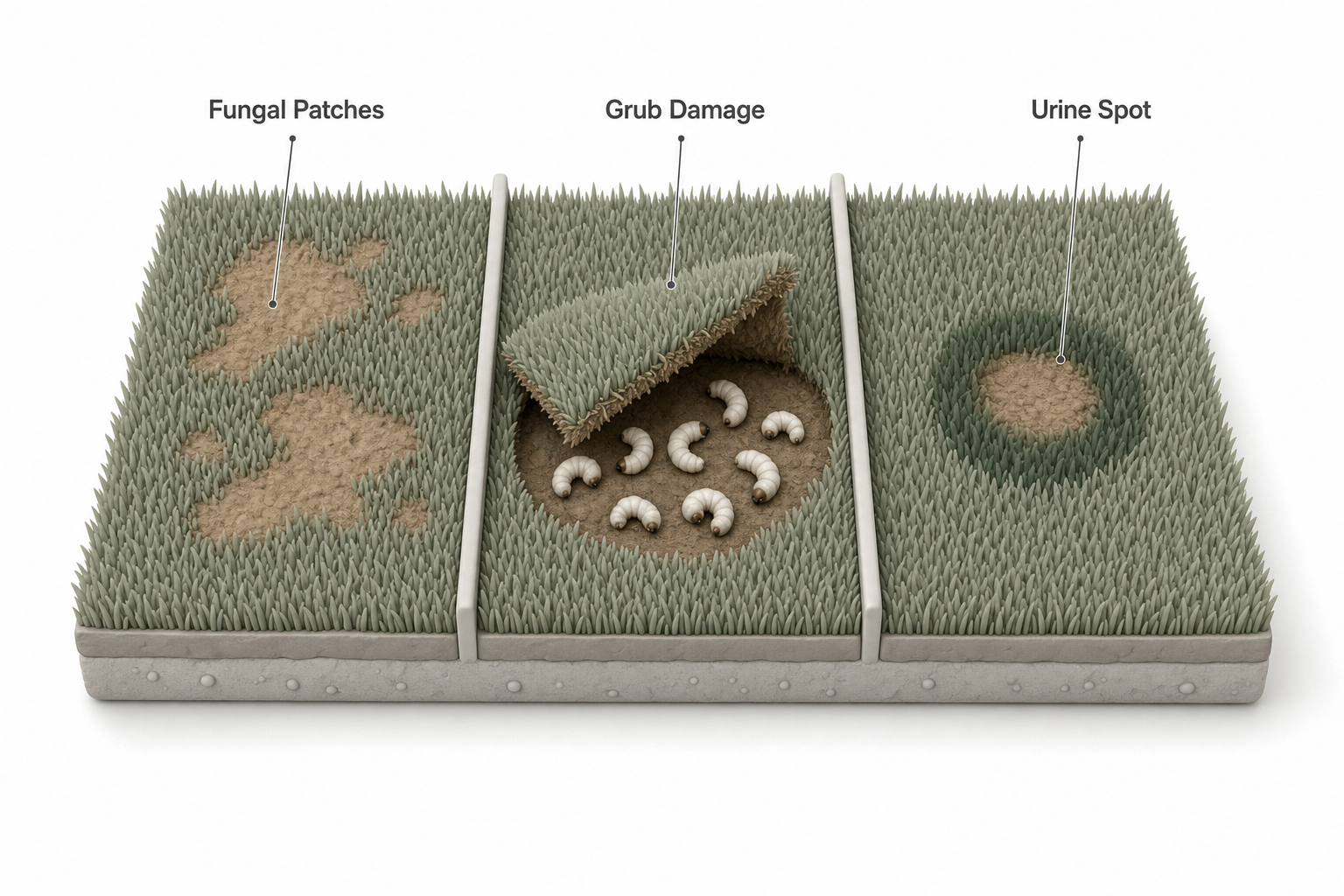
- Irregular, spreading patches with ragged edges that expand outward over weeks usually point to fungal disease.
- Random patches of thin or dead turf that peel back like a loose carpet are the classic sign of grub damage.
- Small, roughly circular dead spots (4in to 10in across) with a ring of darker, greener grass around the outside almost always mean dog urine.
Step 2: Confirm Grub Damage With the Tug Test
White grubs (the larval stage of Japanese beetles, June bugs, and similar beetles) feed on grass roots just below the soil surface, which is why damaged turf lifts up easily.
- Find the edge of a brown patch and grab a handful of grass.
- Pull firmly. If the sod lifts away from the soil like a rug with little to no root resistance, grubs are a likely cause.
- Peel back a 12in by 12in section of turf and count the C-shaped white grubs visible in the top few inches of soil. Many university extension guides suggest that finding more than 8–10 grubs per square foot is often enough to justify treatment, though thresholds vary by grass species and region.
- Check for secondary damage—skunks, raccoons, or birds tearing up the lawn at night are often digging for grubs, and torn-up turf with shallow holes is a strong secondary clue.
Fixing grub damage:
- For an active, heavy infestation, a curative insecticide labeled for grub control can knock down the population, but timing matters: products are typically most effective when grubs are small and actively feeding, often in late summer.
- For prevention, a season-long grub preventer applied in late spring or early summer (before eggs hatch) is usually more effective than waiting until damage appears—check the recommendations below for suitable products.
- Water treated areas as directed on the product label to move the active ingredient down into the root zone where grubs feed.
- Reseed or lay new sod over badly damaged patches once grub counts drop, since dead roots won't recover on their own.
[!region] Grub species and peak activity windows vary significantly by climate and turf type. Contact your local cooperative extension office for region-specific timing and species identification before treating.
Step 3: Identify Fungal Disease
Lawn fungus tends to show up after periods of high humidity, overwatering, or poor air circulation, and it often has telltale patterns beyond just a brown patch:
- Ring or donut-shaped patches that grow outward over time (fairy ring, brown patch fungus).
- Thread-like webbing visible on grass blades in early morning dew (common with several turf fungi).
- Reddish, orange, or yellow discoloration on individual grass blades rather than uniform browning.
- Patches that appear or worsen rapidly during warm, humid, or wet stretches of weather.
Fixing fungal damage:
- Adjust watering first. Most lawn fungi thrive in prolonged moisture. Water deeply but infrequently—typically once or twice a week rather than daily—and always water in the early morning so blades dry out during the day.
- Improve airflow and light. Prune back overhanging branches and thin dense shrubs near affected areas; stagnant, shaded air keeps grass wet longer.
- Dethatch and aerate if thatch buildup exceeds about 0.5in, since thick thatch traps moisture against the soil surface. (Thatch depth isn't a linear measurement in the strict sense, but a soil probe or small spade will show you the layer.)
- Apply a fungicide labeled for the specific disease if cultural fixes alone aren't resolving it—correct identification matters here, since fungicides differ by target fungus. When in doubt, a soil or turf sample sent to a local extension office can confirm the exact disease.
- Avoid heavy nitrogen fertilization during an active outbreak, since excess nitrogen can encourage some fungi; follow label guidance for timing.
Step 4: Confirm and Fix Dog Urine Spots
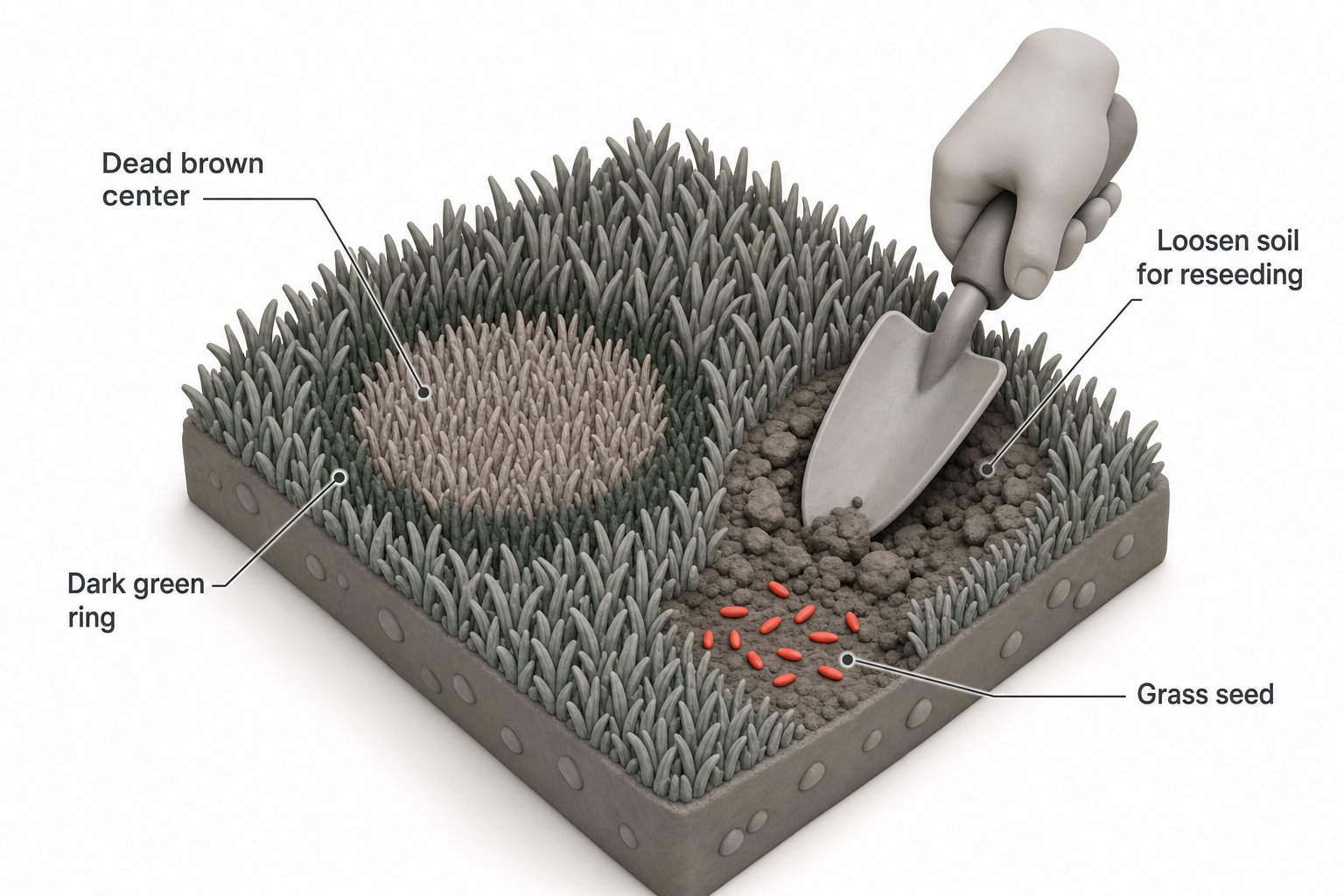
Urine spots are caused by the nitrogen concentration in dog urine essentially burning the grass at the point of contact, while diluted nitrogen at the edges acts like a mini fertilizer boost—hence the dark green ring.
Fixing urine damage:
- Flush the area immediately after your dog urinates, if you can catch it—soaking the spot with a few gallons of water dilutes the nitrogen before it damages the grass.
- Increase your dog's water intake somewhat, which naturally dilutes urine concentration; consult your veterinarian before making significant changes to diet or water routines.
- Train a designated bathroom spot using mulch, gravel, or a hardy groundcover instead of turf, which sidesteps the problem entirely.
- Repair existing spots by raking out the dead grass, loosening the top 1in to 2in of soil, and reseeding with a grass seed matched to your existing lawn type. Keep the area consistently moist (not soggy) until germination, typically {measure:7 days} to {measure:14 days} depending on species.
- Some gardeners try soil amendments marketed to neutralize urine salts; results are inconsistent and prevention/dilution remains the more reliable approach according to most extension resources.
Step 5: When the Causes Overlap
It's common for more than one issue to be happening in the same lawn—grub damage that weakens turf enough for fungus to take hold, or urine spots that get misdiagnosed as fungus because of the ring pattern. If patches don't respond to a fix within {measure:2 weeks} to {measure:3 weeks}, re-examine the area rather than doubling down on the same treatment.
[!safety] Always read and follow the label instructions on any pesticide, insecticide, or fungicide exactly, including reentry intervals for pets and children. If you have a well on your property or live near a water source, check local regulations before applying lawn chemicals, and consider hiring a licensed lawn care professional for large-scale or repeated treatments.
Step 6: Prevent Future Brown Patches
- Mow at the correct height for your grass species—cutting too short stresses turf and makes it more vulnerable to all three problems.
- Water deeply and infrequently to encourage deep roots that resist both drought stress and fungal disease.
- Aerate compacted soil annually or as needed, since compaction worsens grub damage and fungal growth alike.
- Overseed thin areas each fall (or per your region's ideal seeding window) so a dense lawn naturally resists invasion by weeds, disease, and pests.
FAQ
Can I use the same product to treat grubs and fungus at once? No—insecticides and fungicides target completely different organisms and are formulated differently. Treating for the wrong problem wastes money and won't fix the actual damage; confirm the cause first using the tug test and visual patterns above.
Will brown patches from dog urine recover on their own? Sometimes minor spots green up if urine exposure was light and rainfall dilutes the area, but scorched centers usually need reseeding since the grass crown is often killed.
How do I know if grubs are actually the problem and not just drought stress? Drought-stressed grass generally turns brown more uniformly and doesn't lift away from the soil easily, while grub-damaged turf pulls up like loose carpet because the roots have been eaten away.
Is it safe to apply grub or fungus treatments if I have kids or pets who use the lawn? Most products specify a reentry interval on the label—often a matter of hours—but always follow the specific instructions for that product, and consider treating in the evening so the area dries overnight before pets or kids are back on the grass.
Why do the brown patches keep coming back every year in the same spot? Recurring spots often mean an underlying condition hasn't changed—compacted soil, poor drainage, or a shaded, damp microclimate that keeps favoring fungus, or a dog that consistently uses the same corner of the yard.