
Standing in the tool aisle staring at two similar-looking yellow or red bricks with trigger handles, most people just guess. That's how half the garages in the country end up with a drill that stalls out on deck screws and an impact driver nobody uses because it stripped a screw head on the first try. The two tools solve different problems, and once you understand how they deliver power, the choice gets easy.
What a Cordless Drill Actually Does
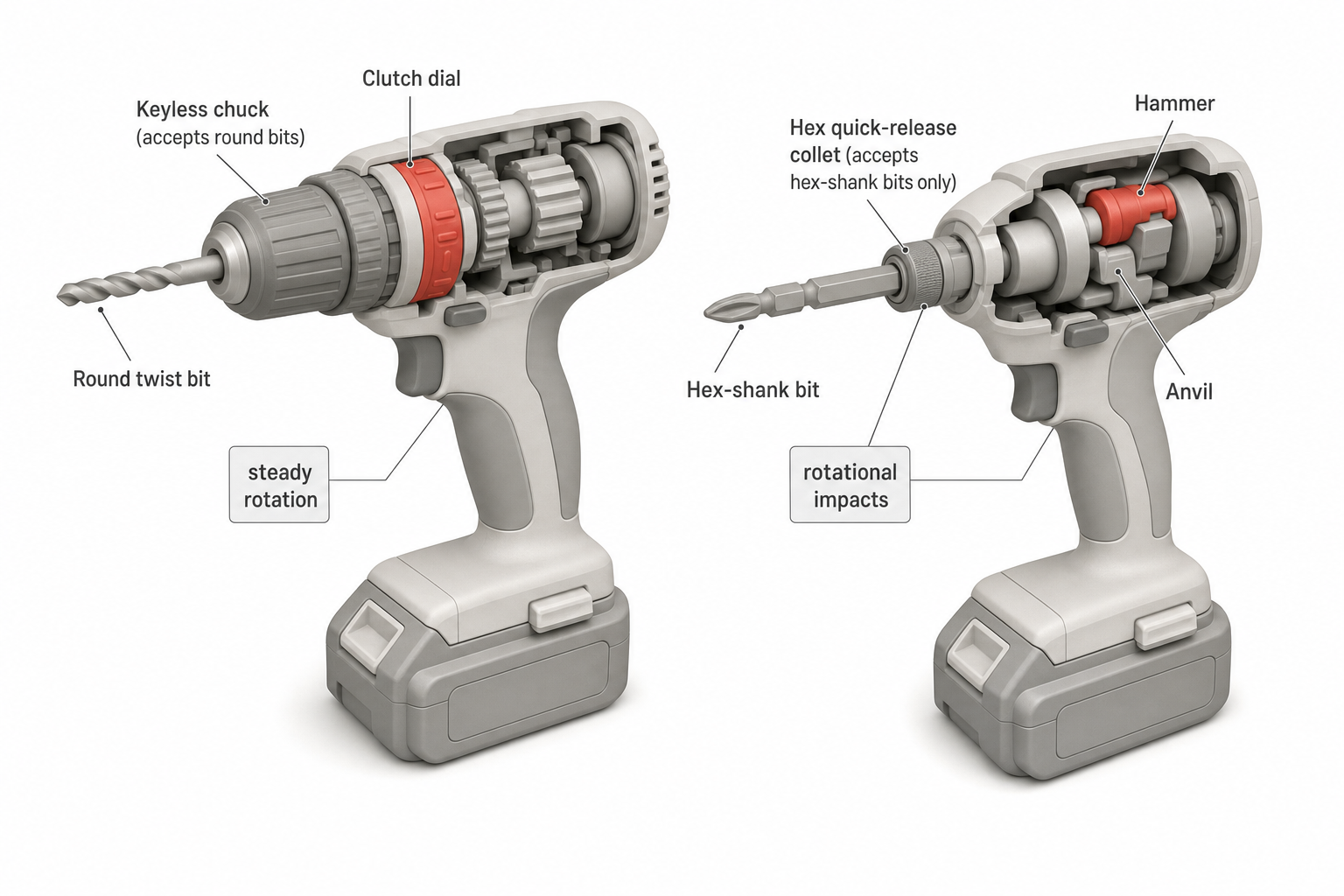
A cordless drill spins a chuck at a controlled, steady speed and applies rotational force smoothly. Most consumer drills have a keyless chuck that opens to about 0.5in, so they accept round-shank twist bits, spade bits, and hex-shank driver bits. A clutch dial near the chuck lets you set how much torque the motor delivers before it slips, which is how a drill avoids stripping a screw head or overdriving a hinge screw into soft pine.
Drills are built for precision: drilling clean holes in wood, metal, or masonry (with the right bit), driving small to medium screws, mixing thin-set with a paddle attachment, or running a hole saw through a stud. The steady rotation is what makes them good at controlled work.
What an Impact Driver Actually Does
An impact driver looks similar but works on a completely different principle. Instead of one continuous twisting force, an internal hammer-and-anvil mechanism delivers rapid rotational hits, sometimes thousands per minute, whenever the tool senses resistance. That's the buzzing rattle you hear when it's working hard. This pulsing action lets a compact tool put out far more torque than a same-size drill without kicking back into your wrist, because the force comes in bursts rather than as one steady twist.
Impact drivers use a quick-release collet sized for 0.25in hex-shank bits only, so they can't chuck a round twist bit or a spade bit. What they're built for is driving: long deck screws, lag bolts, structural screws, and stubborn fasteners that have rusted or backed into hardened material. A driver will sink a 3in deck screw into pressure-treated lumber in a couple of seconds without the tool twisting out of your hand, something a drill would struggle with or stall on.
Torque, in Plain Terms
Torque is rotational force, and it's the number that actually separates these tools, not battery voltage or brand. Compact cordless drills typically top out somewhere in the range manufacturers list as their maximum torque spec, delivered smoothly and controllably thanks to the clutch. Impact drivers of similar size and battery platform commonly deliver two to three times that peak torque figure, but only in short hammering bursts and without a clutch to limit it.
That lack of a clutch is the trade-off. A drill's clutch stops before you strip a screw head or drive a hinge screw through a cabinet door. An impact driver has no such brake: it will keep hammering until the fastener is fully seated or something gives, which is powerful but also why it can snap a small screw or chew up a screw head if you're not careful with trigger control.
Match the Tool to the Job
Reach for a drill when you're drilling holes of any kind, working with fasteners under about 2in where control matters more than power, doing anything that needs a specific bit shape (spade, hole saw, paddle mixer), or working somewhere finish quality counts, like installing cabinet hardware or hanging shelves in drywall.
Reach for an impact driver when you're building a deck or fence, driving long screws or lag bolts into framing lumber, removing rusted or over-torqued bolts, assembling furniture with structural screws, or driving hundreds of fasteners in a day and don't want your wrist to take the abuse. Framers and deck builders lean on impact drivers for exactly this reason: the tool absorbs the reaction force internally instead of transferring it to your arm.
The Case for Owning Both
Most serious DIYers eventually end up with both tools on the same battery platform. A common workflow on a deck build is drilling a pilot or countersink hole with the drill, then switching to the impact driver to drive the screw home. Many cordless brands sell drill and driver as a matched kit for this reason, and it's worth checking the recommendations below if you're shopping for a starter set rather than buying each tool separately from different lines.
If You Can Only Buy One
For a first cordless tool in a household, a drill is usually the more versatile purchase because it handles both drilling and light-to-moderate driving, and its clutch makes it more forgiving for beginners. An impact driver is the better first purchase if you already own a corded or older drill and your main frustration has been stripped screws, stalled bits, or sore wrists from driving long fasteners.
Some manufacturers also sell a hybrid "drill/driver" (not to be confused with an impact driver) that's really just a drill with a higher torque rating; it still lacks the hammering mechanism and won't match true impact performance on long lag screws.
Basic Safety Notes
FAQ
Can an impact driver drill regular holes? Not well. Its hex-only collet can't hold round-shank twist bits, and even with hex-shank drill bits, the hammering action makes it hard to start a clean, accurately placed hole. Use a drill for hole-drilling and save the impact driver for driving fasteners.
Will an impact driver strip screws more than a drill? It can, mainly because it has no clutch to stop it once the fastener is seated. Using a snug-fitting bit, applying steady downward pressure, and easing off the trigger as the screw seats will cut down on stripped heads significantly.
Do I need a big battery for either tool? Battery amp-hour rating affects runtime, not torque output on most cordless platforms, since torque comes from the motor and gearing (or hammer mechanism) rather than the battery size. A smaller battery just means more frequent recharging, not a weaker tool.
Is a hammer drill the same as an impact driver? No. A hammer drill adds a forward-and-back hammering motion for punching through masonry and concrete with a masonry bit, while an impact driver adds a rotational hammering motion for driving fasteners. Some tools combine hammer-drill and driver functions, but they're built and used differently.
What size fasteners are the cutoff for switching tools? There's no strict rule, but many people switch to an impact driver once screws pass about 2in in length or when driving into dense material like pressure-treated lumber, engineered lumber, or old hardwood, where a drill tends to stall or strip before the screw is fully seated.